All teachers, not only reading teachers, can benefit from understanding how students may struggle in reading, in order to better support them in the classroom. While the reading teacher is the primary educator focused on teaching students to read, all teachers across all content areas must be mindful of students’ reading difficulties. Reading is essential to comprehension, and all teachers have a responsibility to ensure that students learn to the fullest extent in the classroom. However, some students struggle significantly more with reading than others. This article will provide you with an overview of what to consider as you encounter students in your class who may exhibit reading struggles, either due to a specific disability or due to other reading difficulties.
Dyslexia: The Most Common Reading Disability
Under IDEA (the Individuals with Disabilities Education Act), most reading disabilities fall under the umbrella of “Specific Learning Disability.” Dyslexia is the most prevalent diagnosis within that category, and it’s important to understand what it actually is.
Dyslexia is a neurological disorder that affects how the brain processes language [https://www.ninds.nih.gov/Disorders/All-Disorders/Dyslexia-Information-Page]. While you primarily see dyslexia presenting in the form of difficulty reading, it can also impact an individual’s ability to spell, listen, or even speak a language. Typical characteristics of a child with dyslexia include difficulty decoding words, difficulty reading fluently, and, as a result, difficulty understanding what they read. To best experience “words moving around on the page”, a common experience for people with dyslexia, you can view this dyslexia simulator. https://geon.github.io/programming/2016/03/03/dsxyliea
Dyslexia can only be diagnosed by a trained medical professional, but it’s still important for teachers to have a basic understanding of dyslexia to develop strategies for supporting students in the classroom. The two most frequent “deficits” among students diagnosed with dyslexia are phonological awareness and rapid naming deficits. Let’s break down each into a bit more detail now.
Phonological Awareness Deficit
Phonological Awareness is the most common deficit that individuals experience, and as a result is often one of the first areas that are assessed when medical professionals attempt to determine if a child may have dyslexia, because the primary feature of dyslexia includes a problem with decoding words. Individuals will have difficulty identifying or manipulating sounds, and the reading difficulty typically is caused by trouble understanding phonemes in words and blends. They struggle with sounding out words, often mispronounce words, and might omit sounds from words. Students may even struggle with rhyming. Overall, deficits in phonological awareness means a student will struggle to identify and manipulate sounds. As a result, they can face extreme difficulty with reading.
Consider this scenario. 1st grade teacher Ms. Matthews has started her unit lesson on poetry. But, for the past few weeks, she has noticed that Grayson is struggling with grasping how to write a poem that rhymes. She realized that although Grayson has not been formally diagnosed with dyslexia, he may be struggling with phonological awareness, where it is manifesting as his inability to be able to understand rhyming. She has reached out to the student support team on campus to determine if he is eligible for testing. In the meantime, to support him, she placed a word family chart into the classroom and also provided Grayson with his own word family cards. Grayson was able to write a poem using the cards that were provided. Many of the other students who struggled also improved significantly because Ms. Matthews was willing to make some adjustments to her lessons in order to meet the needs of her students. In this case, even though Grayson was not diagnosed with dyslexia, Ms. Matthews recognized that his weakness in phonological awareness created problems for him in the classroom. She was able to build correct supports for him- and even helped a few more students in the process!
Rapid Naming Deficit
Rapid Naming Deficit is an additional common deficit that individuals experience and refers to the speed of reading. Individuals with a deficit in rapid naming will have difficulty quickly naming letters, numbers, and even colors on sight. They struggle with their processing speed. For these individuals, it can take longer to read assignments, and these students struggle significantly with time-based assessments. Rapid Naming issues may also cause children to say incorrect words when attempting to read. Because students may take longer to read, this deficit can also impact their reading comprehension and ability to process information.
Consider this 9th-grade student, James, who struggles with rapid naming. James is an excellent student, and while he often seems to be daydreaming in class, not following along with the notes or passages that are being read in class, he is always well- prepared for tests and quizzes. This class is a reading- heavy class, and most of the content students learn comes from textbook assignments or first- person historical accounts that students must read in class. Mr. Grimes, his history teacher, has begun requiring students to read parts of their history textbook aloud before whole class discussions, but James always refuses and is even sometimes defiant towards Mr. Grimes. Eventually, Mr. Grimes conferences with James to discuss what he perceived to be a disciplinary issue and learned some important facts about James. James struggles with reading and takes much longer to read text than his peers. He is embarrassed to read aloud in class, and he often takes his work home and reads his notes and textbook because he can’t easily follow along in class. His excellent grades are despite his disability- he spends a longer time at home reviewing and studying content since he misses a lot of the reading during class time. Mr. Grimes realized that his lesson strategy and learning activities were not varied enough to meet the needs of students like James, and he began to consider additional ways students could interact with the content as he planned future lessons.
Other Deficits
Dyslexia can also produce many other areas of deficit (typically as a secondary characteristic to the deficits named above) in individuals, including:
- Reading comprehension, where their difficulty with reading results in students not fully understanding the text.
- Fluency, for example struggling with sounding out words accurately and quickly due to their issues with recognizing the words on paper.
- Writing, for example being able to orally recall information but being unable to accurately write down that information.
- Spelling, where a student may omit sounds, add extra sounds, or write down the wrong letters during a spelling test or during any given writing tasks.
Consider this scenario to think about how certain deficits may manifest in the classroom. Joy is a 5th-grade student diagnosed with dyslexia, and her teacher, Ms. Parker, makes sure that she provides reading supports based on Joy’s education plans to assist with her disability. Ms. Parker notices that after she introduced the newest chapter book to her students, Joy has been struggling with answering oral questions about the text they have been silently reading. Ms. Parker has begun frequently correcting Joy’s retelling of the information when provided with a writing prompt. At her next writing conference, Joy describes her disability to Ms. Parker in more detail. She tells Ms. Parker that the words are harder to read in this book with its smaller print, longer chapters, and less time to read. It makes it difficult to keep up with what she is reading, causing her to miss parts of the story. Since Ms. Parker times the students for their reading and writing activity, Joy rushes to complete the reading and misses key parts of the story. Ms. Parker realizes that Joy’s dyslexia isn’t simply a reading issue she should be working to support- it is causing issues in many other areas of literacy that Ms. Parker has not been supporting. Ms. Parker found a different book with a larger font for Joy, provided her with a modified reading schedule, and also gave her some guided notes to help Joy identify key parts of the story she should write about. As the text’s complexity increased, Ms. Parker realized that Joy needed additional support in other areas to be successful in the classroom.
Non- Disability Reading Difficulties
As you may be aware, some children do not have a reading or other disability but may still struggle with reading in some way. Some generalized examples include:
- A child who is not read to or does not read books at home is more likely to have a lower reading level than peers whose parents do read to them.
- An English Language Learner who is simultaneously learning the language while also learning to read may experience a greater learning curve when mastering reading.
- A child who has missed a significant amount of schooling or who enters school late may be behind in reading compared with his peers.
Supporting your Students
Regardless of your students’ needs, you can implement strategies that can support ALL students in your classroom. Continuing to learn more about specific strategies to help your students and regularly incorporating them into your classroom will provide all your students with the support they need for reading success [https://www.understood.org/en/school-learning/partnering-with-childs-school/instructional-strategies/at-a-glance-classroom-accommodations-for-dyslexia].
When combining support and strategies with explicit, systematic reading instruction [https://www.modelteaching.com/education-articles/reading-ela-instruction/explicit-systematic-and-sequential-reading-instruction], you can ensure you create a robust learning environment for all students, especially those with specific reading struggles or disabilities.
Try This:
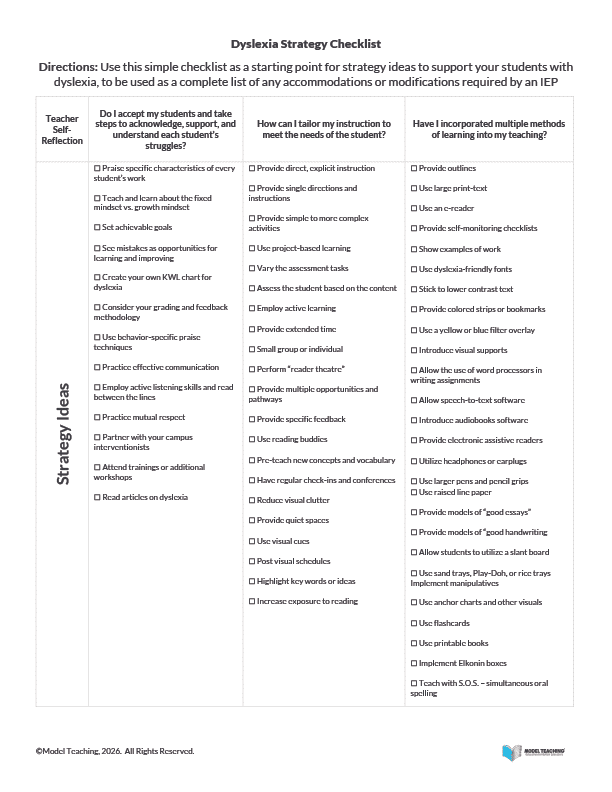
Think about an upcoming lesson, and consider whether you are adequately implementing strategies to support all students in reading in your classroom. You can use our Dyslexia Strategy Checklist to guide you in your reflection. Then, choose 1-2 strategies to implement for an upcoming lesson.