Chat with us, powered by LiveChat

Home  »  Education Articles  » Checking For Understanding
  • Sight words app

Sight Words and Orthographic Mapping: A Free Practice Tool That Reinforces Your Phonics Instruction

August 26, 2026|

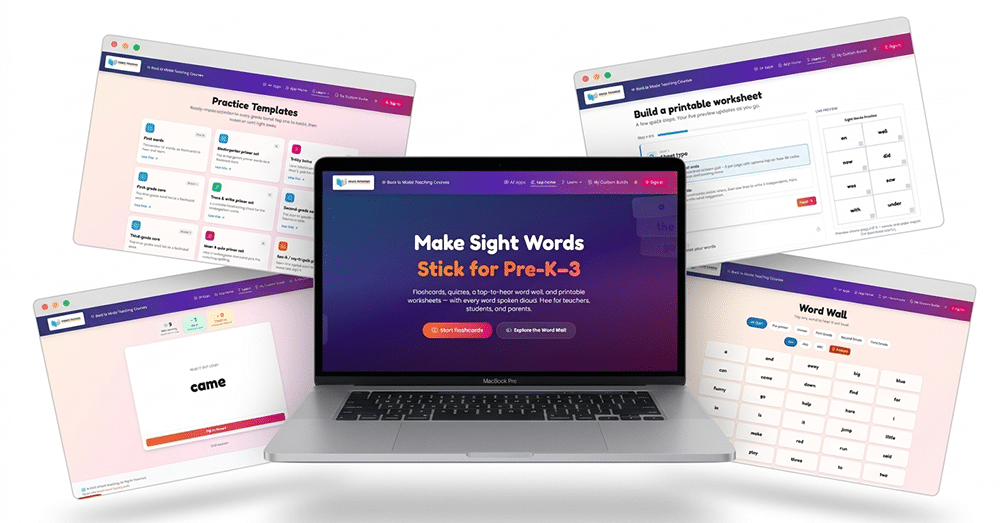
Imagine a first-grade teacher finishing a week of high-frequency word instruction. Her students had practiced the week's ten words every day, chanting them at morning meeting, tracing them on whiteboards, sorting them into a pocket chart, and nearly every child passed Friday's quiz. Then, on Monday, as she worked in a small group of students, she noticed a student who stopped at the word "said". He looked at the page, tried "sad" and "sat," and then just skipped it altogether. He got the word right last week on his quiz! The teacher's first instinct is reasonable on the outside: "he just needs more repetition and more time memorizing this word!" But the trouble she is missing is that he hasn't actually practiced decoding the word to help move the word into storage. Pure memorization alone, this teacher quickly realizes, is not the way to ensure students master sight words. This article discusses how high-frequency words become sight words, and why explicit attention to letter-sound structure is what really helps students master sight words. You'll leave this article with an understanding that sight word practice can be a necessary component of reading practice, but as a supplement to, and not a substitute for, the strong reading instruction you are doing in your classroom.

  • Model Teaching - Geography Study

Building Geography Knowledge: Retrieval Practice of Countries, Regions, and Geographical Features

June 24, 2026|

Imagine a middle school teacher finishes a unit on East Asia. Students had been working on identifying and locating physical and geographic features on a map, like landforms, bodies of water, and urban centers, as well as identifying the location of countries around the world. In this unit, the teacher described the region’s monsoon climate, and students learned why its rivers support a denser population than in other areas. While students are engaged in the content throughout the unit and analyze a map of the region as they discuss its features, they have a hard time identifying geographic features on their own. For example, when the teacher projects a blank map onto the board and asks students to identify the Yellow Sea or label countries like China, Japan, and North and South Korea, many students are unable to do so, even though they discussed these areas in class extensively. (Read More)

  • Answer Justification

Use the Answer Justification Process to Improve Your Students’ Test-Taking Skills

February 12, 2026|

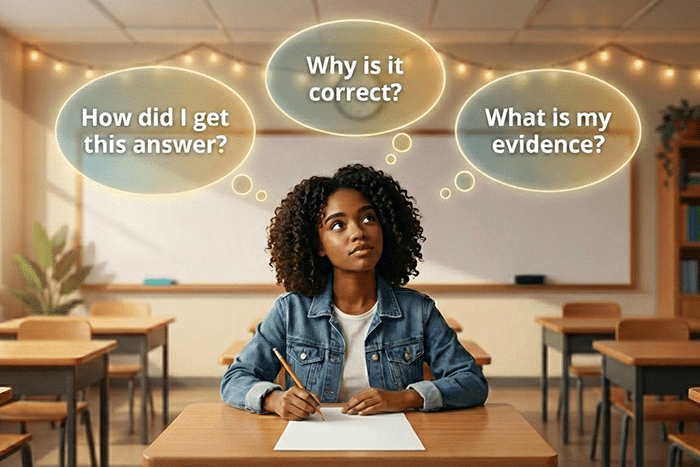
Test success is not just about students mastering content and then demonstrating it. Many students also need support in mastering specific testing behaviors that will increase the chance of their success on a test. Whether that is time management, a method for analyzing a question, or a method for selecting the correct multiple-choice option on tricky tests, testing behaviors can be improved and practiced in students as a way for them to truly demonstrate what they know and guarantee better success on assessments.

  • Student Feedback

A Formula for Student Feedback

March 23, 2023|

Your students need a model for improving their work; with timely and specific feedback, it will be easier for them to work to improve in certain areas. Student feedback identifies particular areas of student performance and provides insight into their strengths and weaknesses. Therefore, feedback should be a natural component of most assessment methods you provide in your classroom. This article will give you a brief set of steps to help you build timely and targeted student feedback.

  • 3-2-1 Strategy

The 3-2-1 Strategy to Check for Student Understanding

January 3, 2023|

Ideas and strategies to check for student understanding are plentiful. You may find that you’ll use several different methods within each classroom and choose methods specific to the task students complete. A large toolbox of strategies to pull from can help ensure you understand exactly what each student knows. When designed correctly, your methods to check for student understanding can also work to support students in self-analyzing their learning to train them to think critically about what they do and do not know. The 3-2-1 Strategy is a simple yet effective method you can introduce to your students to learn what they know and to help them analyze it for themselves.

  • The Four Corners Teaching Strategy

The Four Corners Strategy-A Verbal, Active Method to Check for Understanding

May 11, 2022|

The Four Corners Strategy is a simple verbal strategy to help engage your students and improve discussion and discourse. In Four Corners, a question is presented to the class, and students are given time to think about their responses. Students will respond to the question by standing in a designated spot of the room that represents their answer choice. Typically, you allow for each corner of the four corners of your classroom to convey an answer choice. After posing your question, students will reflect on their answer and then move to their designated corner of the room. The Four Corners Strategy is a wonderful way to encourage debate and discourse in the classroom while also visualizing students' differences in ideas. By posing questions that elicit a more open-ended response, you can encourage students to think more critically about the question and their answer and prompt them to justify their choice.

  • Student Response System

The Student Response System as an Effective Verbal Strategy to Check for Student Understanding

April 12, 2022|

A simple verbal strategy to check for student understanding throughout your lesson is the Student Response System and is the focus of this article. This strategy presents questioning prompts in multiple-choice or true-false format for students to answer in real-time. Students will respond to the prompts using pre-made cards with A, B, C, D, True, False, or other information to indicate their selection of an answer choice displayed on the board. The student response system can be prepared easily by cutting out printed cards, laminating them, and making them available to each student in your classroom. If you have it available at your school, there are also electronic versions of this student response system, commonly known as Clickers. Physical devices may be available for use at your school, or you may have an app or website that you can access to employ an online student response system.

Your Shopping Cart

Name Price
Buying for a team or group? Select quantities on checkout page.