Use the Answer Justification Process to Improve Your Students’ Test-Taking Skills
Published February 12, 2026
Share This Article:
Testing Behaviors
Test success is not just about students mastering content and then demonstrating it. Many students also need support in mastering specific testing behaviors that will increase the chance of their success on a test. Whether that is time management, a method for analyzing a question, or a method for selecting the correct multiple-choice option on tricky tests, testing behaviors can be improved and practiced in students as a way for them to truly demonstrate what they know and guarantee better success on assessments.
Internal Testing Behaviors
Internal testing behaviors involve your students’ thought processes as they grapple with test questions and make decisions about choosing or writing the correct answer. While you cannot observe these internal testing behaviors in action, you can help prepare students to practice them on the test and reinforce them as self-reflection sessions later in the review. This article will teach you one method for helping your students practice an internal testing behavior: the Answer Justification Process.
The Answer Justification Process
The answer justification process is a method students should use both as a study tool and a self-check on the test. In answer justification, students will think about their answer and justify to themselves why it is the correct answer. These behaviors occur internally for your students, so while you cannot monitor them during the test to observe whether they exhibit these behaviors, you can model and practice these behaviors with your students before the test as a review, and again after the test as a self-reflection strategy.
The answer justification process is any method for students to self-check and deeply analyze their answer responses. It helps avoid careless mistakes, adds depth to short answer responses, and provides a way for students to self-analyze their progress and identify areas they still need to study and work on. The justification aid below is only one method students can employ as they review test questions and answers. You may have a different process that you use, but this suggested answer justification method gives a structure for students to practice as they work through problems. The answer justification process is as simple as coaching your students to reflect on each answer before they move on to the next question.
- HOW did you get 35?
- HOW did know it was about bees?
- HOW can you tell this is spelled wrong?
- WHY did you choose multiplication instead of addition?
- WHY do you think Maria is afraid of bees?
- WHY did you choose to add this detail?
- WHAT information in the word problem tell you to multiply?
- WHAT information in the text tells you that Maria is afraid?
- WHAT notes or rules are required for you to answer this question?
How to Use the Answer Justification Process
As your students approach each test question, they should answer the question by utilizing this or another answer justification process that you explicitly teach.
- How did I select the answer?
- Why is that the answer?
- And how do I know this, based on my evidence?
This process requires self-reflection as students think clearly about each question and answer on a test. Students should ask, then answer, each of these questions for every problem they encounter on a test.
For short-answer questions: Following the answer-justification process for each short answer a student completes will help them identify gaps in their answers, self-check that their evidence is accurate, and ensure the correct level of detail is present in each answer choice.
For multiple-choice questions: Completing an answer justification process for each answer choice allows students to first clearly identify why each answer choice is incorrect, and finally identify the rationale for why their selected answer is correct. They can work to eliminate each incorrect answer, providing justification for their answer and crossing out incorrect answers. Then, they can finally select the correct answer once they are satisfied with their answer justification. This process can help students reduce careless mistakes, identify more ambiguous answer choices, and self-check their work as they select their final answer.
Teaching and Supporting Students in Utilizing the Answer Justification Process
The answer justification process should always be used on a student’s tests as he or she selects the correct answers. However, this process is just as valuable as a study tool prior to the test and a self-reflection tool after the test when students analyze the questions they got wrong.
-
- First, explicitly teach this answer justification process or another one you design for your own class and content area. You should model the thought process you utilize to select an answer choice: How did you get your answer? Why is it the answer? What is your evidence? Incorporate this process into your daily lesson activities. When students are asked to complete a question or a set of questions in class, model the answer justification process when reviewing the correct answer choice. Then, ask students to practice this process themselves, both in small groups and independently. Requiring students to utilize this strategy before a test helps them to internalize the rules and concepts they must know for their assessment and practice this skill in more detail.
- During the assessment, you may wish to post the steps for the answer justification process on your board or provide students with a cutout of each reflection they should internally answer for every test question. As you roam the room and observe their external behaviors, notice students actively checking their work. Then, provide feedback and remind students to use the answer justification process when checking their answers before turning in their test.
- Finally, after the assessment, your students should have a chance to reflect on the answers they got wrong and think about why the correct answer is, in fact, correct. Requiring students to complete this answer-justification process after an assessment helps them immediately address misconceptions they may have and strengthen their knowledge of concepts for future assessments.
Answer Justification in Action:
Here’s an example of one student utilizing the answer justification process, and one student who is not, to help you consider what this might look like during a test for your students:
He uses the answer justification process to go back to the text for each answer and attempts to use the evidence in the text to justify the answer response. Returning to the text and using evidence in his answer justification process helps him more easily eliminate incorrect answer choices.
Though he sometimes still gets some of the answers wrong, his scores accurately reflect his ability to understand the passages, largely because he uses this approach.
When he reviews his incorrect answers after receiving his test back, he works in a pair with another classmate to rationalize the correct answer for each question he got wrong, again utilizing the answer justification process. This helps him uncover some nuances in the text he missed the first time and ultimately helped him strengthen his critical reasoning skills.
He doesn't feel the need to perform the answer justification process for his answer choices because he feels fairly confident that he can select the correct answer with his knowledge from the passage he just read.
While he typically performs well in these assessments, he misses a few questions in each test because they involve more complex higher-order thinking to correctly answer the question.
He unfortunately rarely learns from these mistakes, however, because he does not take the time to analyze his questions when his test is returned and does not utilize any answer justification strategies to practice selecting the correct answer for those types of questions.
Try This:
Teach this strategy to your students, and provide each student with a small card reminding them of the three questions they should ask themselves for each test question. You can find a resource to print for your classroom below.
Article by: Model Teaching
Model Teaching, a leader in K-12 teacher training & professional development.
Read Time: 6.8 Minutes
Popularity/Post Views: 3,798
Related Professional Development Courses

Behavior Strategies for Improved Testing Performance
Learn how to teach testing behaviors, testing strategies, and a process for students to justify their answer choices on assessments. You will learn specific strategies and methods to explicitly teach appropriate testing behaviors.
PD: 1 Hour
Semester Credits: 1 Credit

Choosing The Right Assessments For Your Students
This course will teach you the different types of assessments, how to design effective and targeted assessment items, and how to build a detailed plan for your content area and grade-level to measure student progress.
PD: 16 Hours
Semester Credits: 3 Credits

Diagnostic Assessments: An Overview
This Quick Course will teach you about the common types of diagnostic assessments, the components of a strong diagnostic assessment, and what to do with the result from your assessments.
PD: 1 Hour
Semester Credits: 1 Credit

Measuring Growth in Writing Using Rubrics (Gr K-3)
Learn what typical writing looks like for kindergarten through third-grade students, as well as some common writing tasks they can be expected to accomplish and learn the purpose of both holistic and analytic rubrics for writing assessment.
PD: 8 Hours
Semester Credits: 1 Credit

Teacher & Student AI Apps
We believe in using AI and digital tools to improve thinking, not replace it. Our apps are built to support teachers in their planning and students in their practice, designed around what research tells us actually works in the classroom.
Downloads & Resources
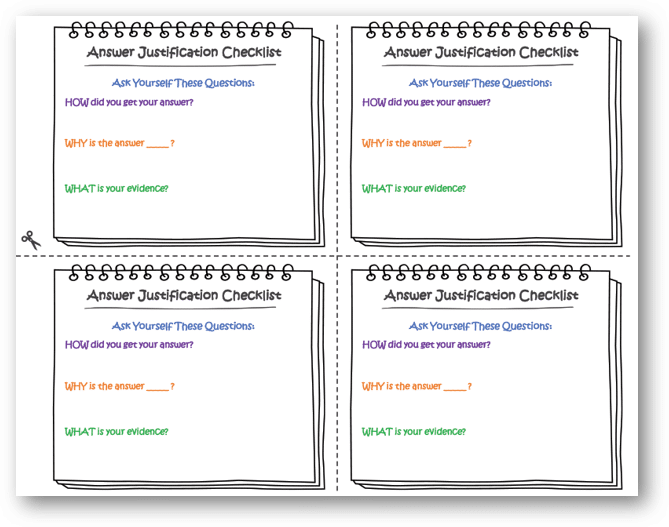
Answer Justification Checklist
Use this resource by printing it out and giving it to your students. It will allow them to follow the answer justification process.
Suggested Citation: Pond, Shayna. Use the Answer Justification Process to Improve Your Students’ Test- Taking Skills. Model Teaching, 2025.
https://www.modelteaching.com/education-articles/testing-strategies-prep/answer-justification-to-improve-test-taking-skills
Related Articles