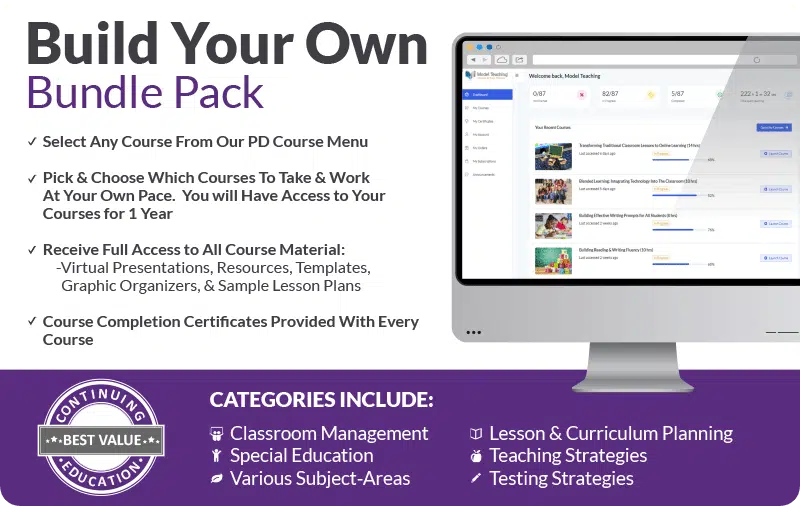
Access to All PD Courses. The most cost-effective way to earn your required Professional Development hours. Once you purchase your hours bundle, you may choose any courses from our full PD course menu until you have used all hours. Access your courses for 1 full year.

Access to All Graduate-Level Courses. The most cost-effective way to earn Graduate-Level credits! Purchase your bundle, then choose any of our university-partnered courses. Access your courses for one year and work at your own pace. Pay the $70/credit fee as you go or when you finish.

Learn about the six co-teaching models, as well as how to implement co-teaching in their classroom from the initial planning stages, all the way through setting curriculum goals, and making modifications.

This course will teach you about the six co-teaching instructional models and how to implement co-teaching in the classroom successfully.

In this course, you will learn about the components of effective academic discussion and will be provided with everything you need to build a complete plan to implement academic discussions in your classroom while ensuring students master content knowledge aligned with your lesson objectives.

In this course, you will learn about the components of effective academic discussion and will be provided with everything you need to build a complete plan to implement academic discussions in your classroom while ensuring students master content knowledge aligned with your lesson objectives.

This course series contains curated courses from the Model Teaching platform that provide teachers the tools to address and eliminate learning loss in the classroom as well as risks of academic, social, and emotional decline.

This course goes beneath surface-level classroom management systems to explore the behavioral science and psychology behind student behavior. You will learn 12 research-backed theories organized around three drivers of behavior, along with implementation strategies to improve student behavior.

This course will define developmental theories and how they drive teaching and learning practices. You will learn about various psychosocial, behavioral, and cognitive developmental theories, and why this knowledge is critical for educators.

This course will define developmental theories and how they drive teaching and learning practices. You will learn about various psychosocial, behavioral, and cognitive developmental theories, and why this knowledge is critical for educators.

Learn how to design a behavior contract for the students in your classroom. You will learn about choosing reinforcers for a desired student behavior, considering tracking methods and behavior contract design, and general ideas for behavior contract implementation.
Learn how to design a behavior contract for the students in your classroom. You will learn about choosing reinforcers for a desired student behavior, considering tracking methods and behavior contract design, and general ideas for behavior contract implementation.

In this Quick Course, you will learn about the benefits of brain breaks and explore simple brain break strategies you can implement through your lessons. You will also learn about the BOOST method for implementing brain breaks effectively in your classroom.

Learn about the benefits of brain breaks and explore simple brain break strategies you can implement through your lessons. Learn to plan and implement brain breaks using the BOOST template and leave the course with ideas for implementing brain breaks in your classroom.

This course will teach participants how to establish a classroom culture that is conducive to learning and sharing as well as a variety of ways to check their students’ understanding of elementary math content.

This course will teach participants how to establish a classroom culture that is conducive to learning and sharing as well as a variety of ways to check their students’ understanding of elementary math content.

In this course, you will learn the 6 most common and low-prep models to plan and implement collaborative learning in your classroom and help you create a learning environment that promotes student discussion and success.

This quick course will help you plan for the design of a strong substitute teacher folder so that in the event of your absence, your substitute teacher can successfully deliver lessons. STRONG sub folder components are defined, with guidance on how to successfully plan for your absence.

This quick course will help you plan for the design of a strong substitute teacher folder so that in the event of your absence, your substitute teacher can successfully deliver lessons. STRONG sub folder components are defined, with guidance on how to successfully plan for your absence.

In this course, you will explore how to process, file, and analyze data for documentation as well as build a documentation action plan to help you document student academic and behavioral trends.

This course will show you the specific processes to effectively manage your classroom and maintain order throughout your lesson cycle so you may decrease disruptions and improve student learning.

In this course, you will learn the six strategies to improve the learning environment, so your classroom is predictable, safe, orderly, and more conducive to student learning.

This course will cover the values (both social-emotional and academic) of building strong home-to-school connections. Learn strategies for building connections and keeping parents engaged, with clear, frequent, and positive communication.

This course will cover the values (both social-emotional and academic) of building strong home-to-school connections. Learn strategies for building connections and keeping parents engaged, with clear, frequent, and positive communication.

This Quick Course will teach you about the need for students with Autism to work within a predictable and structured environment. In order to lessen anxiety, improve behaviors, and create calm and peace within your classroom.

In this introductory-level course, you will learn methods for documenting a student’s academic and social behaviors in the classroom and why this documentation is important to student success.

In this course series, you will learn how to actively monitor students throughout the instructional process, collect academic and behavioral data as well as how to process, file, and analyze data for documentation and better decision making.

This Quick Course will teach you about how to begin planning for student discourse in your classroom. Ideal for teachers new to implementing discourse, you will learn about providing questioning prompts to students and grouping activities to facilitate discussions and ideas for supporting and addressing challenges.

This course will teach you about how to begin planning for student discourse in your classroom. Ideal for teachers new to implementing discourse, you will learn about providing questioning prompts to students and grouping activities to facilitate discussions and ideas for supporting and addressing challenges.

In this course, you will learn the importance of maintaining professional boundaries with your students. The course will discuss emotional / relationship, power, physical and communication boundaries and then provide you with some specific insights into how to plan for maintaining appropriate boundaries within your classroom.

In this administrative course, you will learn the importance of maintaining professional boundaries with your students. The course will discuss emotional/relationship, power, physical and communication boundaries and will provide helpful strategies.

This 4-course bundle contains four courses that will help you build a strong classroom management plan and then put supports in place to manage and improve student behaviors and will teach you how to design efficient classroom processes for a more orderly classroom.

Learn about the benefits of movement through physical activity. You will explore the benefits of physical activities and some ideas for incorporating movement into your content area. Finally, you will consider how you can implement specific physical activities into an upcoming lesson.

Explore the benefits of physical activity in the classroom and learn ideas for incorporating movement into your content area. You will also leave the course with a GETUP resource that provides you with physical activity ideas and examples.

Learn about the MTSS framework, its origins, and its role in classroom and school-wide interventions. Learn about the MTSS tiers and how they address academic, behavioral, and social-emotional needs, along with examples of preventive interventions at each tier.

Learn about the MTSS framework, its origins, and its role in classroom and school-wide interventions. Learn about the MTSS tiers and how they address academic, behavioral, and social-emotional needs, along with examples of preventive interventions at each tier.
This course will help you explore different types of Outdoor Education, the benefits of Outdoor Education, and activities to incorporate it into your classroom. You will be provided with specific activity ideas to implement now or with some planning, and you will be inspired to design new ways for students to engage with nature.

This course will help you explore different types of Outdoor Education, the benefits of Outdoor Education, and activities to incorporate it into your classroom. You will be provided with specific activity ideas to implement now or with some planning, and you will be inspired to design new ways for students to engage with nature.

Learn the cyclical process of action research in a classroom setting and how it drives continuous improvement. Learn the steps of the process, including identifying a problem, reviewing current literature, finding a solution, testing the solution, analyzing data / making a conclusion, and sharing the results.

Learn the cyclical process of action research in a classroom setting and how it drives continuous improvement. Learn the steps of the process, including identifying a problem, reviewing current literature, finding a solution, testing the solution, analyzing data / making a conclusion, and sharing the results.
Learn the benefits of productive struggle and methods for creating activities that support students through challenging tasks. You will learn what makes a good activity to support struggle, common hurdles to address in your lessons, and simple strategies to support students throughout their tasks.

This course teaches you the benefits of productive struggle and methods for creating activities that support students through challenging tasks. You will learn what makes a good activity to support struggle, common hurdles, and simple strategies to support students throughout their tasks.

This course will teach you how to provide structured, specific, and actionable feedback to your students. You will learn how to design criteria to observe, collect evidence, and write both positive and improvement feedback that will help your students reach your goals.

This course will provide you with a detailed overview of social-emotional learning (SEL) and the value of incorporating SEL into the classroom to help improve academic success and emotional intelligence.

This course will provide you with a detailed overview of social-emotional learning (SEL) and the value of incorporating SEL into the classroom to help improve academic success and emotional intelligence.

This course explains the three main types of engagement, reviews the levels of engagement, and provides strategies for specific elements of teaching that you can use to engage your students.

This course explains the three main types of engagement, reviews the levels of engagement, and provides strategies for specific elements of teaching that you can use to engage your students.

This course provides participants with specific methods to implement strategies in the classroom that foster student independence while still building a strong classroom culture, expectations, and appropriate methods to manage misbehavior.

This course provides participants with specific methods to implement strategies in the classroom that foster student independence while still building strong classroom culture, expectations, and independence.

Though not a comprehensive list of special populations, this collection of Quick Courses provides you with a variety of ideas for how to support different types of students in your classroom.